Skip to content
Our Products

SaaS Platforms We Build & Run

Not just an agency — we operate our own products in production. Here's what we've built.

SuperApp

Multi-Vertical Marketplace Platform

White-label marketplace platform for food delivery, retail, supermarkets, and more. Multiple vendors manage their stores and orders through one unified system — under your brand, with transparent per-order pricing.

  • Multi-vendor marketplace management
  • Food, retail & supermarket verticals live today
  • Auto-dispatch + DoorDash Drive, Uber Direct, Shipday, Nash
  • Two-way POS sync: Clover, Square & Toast
  • Stripe, Finix, Paytrail & 20+ regional payment networks
  • Loyalty, voucher campaigns, memberships & customer segments
  • 75+ built-in reports with CSV export
  • Per-tenant branding & multi-language support

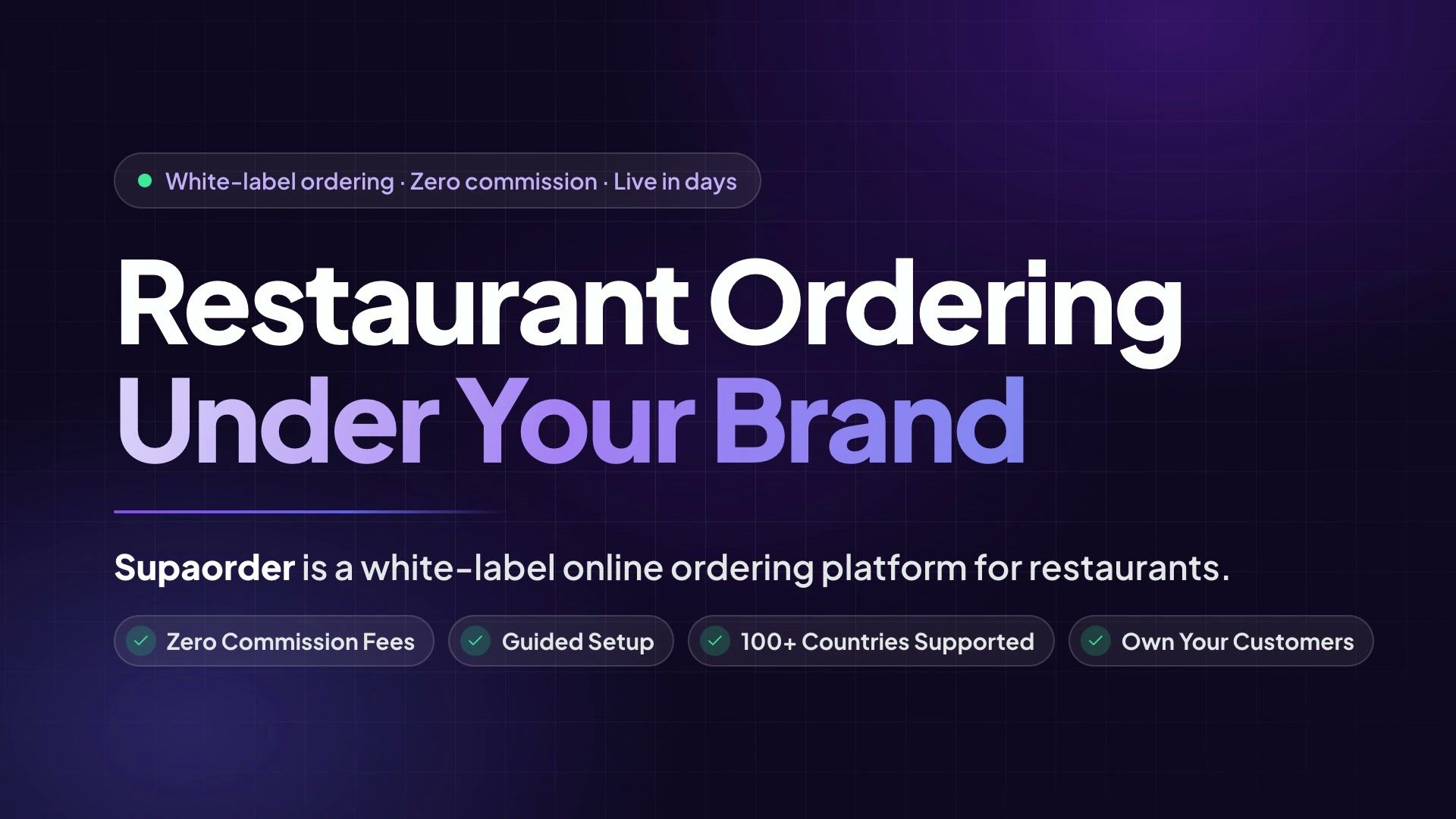
Supaorder

Restaurant Ordering Platform

White-label ordering platform built for restaurant brands. A complete solution for restaurants to own their online orders and customer relationships — with zero commission fees.

  • Zero commission — flat monthly fee
  • Branded iOS, Android & web ordering apps
  • Delivery, pickup, dine-in & scheduled orders
  • Two-way POS sync: Clover, Square & Toast
  • Auto-dispatch + four third-party delivery networks
  • Loyalty points, vouchers & Apple/Google Wallet passes
  • Live order editing with automatic refunds
  • Bluetooth thermal & cloud receipt printing
Shared Foundations

Two Products, One Architecture

SuperApp and Supaorder solve different problems on top of largely the same platform. That is deliberate — and it is the half a client project ends up inheriting.

SuperApp is a white-label marketplace platform — food delivery, retail and supermarkets under one operator's brand, with many independent vendors trading inside it. Supaorder is a white-label ordering platform for a single restaurant brand that wants its own apps and no commission on its own customers. Different buyers, different economics, genuinely different products.

Underneath, they share the subsystems that are expensive to get right and pointless to build twice. Both are multi-tenant: one deployment serving many businesses, each with its own branding, configuration, users and data, isolated from the rest. Both sync two ways with Clover, Square and Toast — which in practice means reconciling menus, prices, modifiers and order state with a point-of-sale system that was never designed to be anybody's source of truth. Both dispatch deliveries, in-house drivers first and out to DoorDash Drive, Uber Direct, Shipday or Nash when there is nobody to take the job. Both run loyalty, vouchers and customer segments on the same primitives. Both take money, and money is where the long tail lives: SuperApp alone settles through Stripe, Finix, Paytrail and more than twenty regional payment networks, each with its own opinion about what a failed charge means.

That shared layer is what a client project inherits. When a marketplace needs dispatch, a retail client needs POS reconciliation, or a B2B product needs per-tenant branding, the estimate is not extrapolated from a blog post — it comes off a subsystem we own, operate and support.
Shared across both platforms

  • Multi-tenant isolation, with per-tenant branding and configuration
  • Two-way POS sync with Clover, Square and Toast
  • Auto-dispatch to in-house drivers, then out to DoorDash Drive, Uber Direct, Shipday or Nash
  • Loyalty points, voucher campaigns and customer segments
  • Branded customer apps for iOS, Android and web
  • Reporting with CSV export — 75+ built-in reports on SuperApp
  • Payment processing across regional networks — Stripe, Finix, Paytrail and 20+ more on SuperApp
Why It Matters

Product Experience You Can Hire

Everything we learn running SuperApp and Supaorder flows directly into the software we build for clients. Here is what that actually taught us.

Architecture We Already Run

Multi-tenant isolation, subscription state, payment reconciliation and real-time order flows are not things you learn from a tutorial and then get right at scale. They are learned by running them — by finding out that a tenant's timezone setting reaches all the way into reporting, that a payment webhook can arrive twice, and that an order edited after dispatch has to reconcile against a printed receipt, a POS ticket and a courier who already left.

Those arrive in a client project as decisions rather than experiments. When we argue that a schema should carry a tenant id from the first migration, or that refunds need an audit trail before they need a screen, it is because the alternative already cost us something.

We Carry the Pager

A studio that only builds is optimised for handover. We cannot hand SuperApp or Supaorder to anyone, so both have to be operable by us at three in the morning — and that changes what gets built. Monitoring and structured logs are part of the definition of done. An upgrade has to roll forward across every tenant without a maintenance window. Configuration lives somewhere a support person can reach without a deploy.

Client projects inherit the bias. What you get is designed for the two years after launch rather than the demo at the end of the project, which is also why every engagement closes with a warranty period and most carry on into a support retainer.

Written for Year Three

Both platforms have been in production long enough for the shortcuts to come due. Code we wrote in a hurry, we maintain. Abstractions we invented to save a week, we live inside. Nothing teaches restraint like being the team that has to open the file again two years later, and nothing exposes a clever idea faster than a support ticket about it.

That is the whole argument for hiring a studio that also ships products: the incentives point the same way as yours. We are not optimising for the shortest path to a signed handover, because on these two we have never had one.

Go Deeper

Read the Product Sites Themselves

Each platform documents its own capabilities and pricing — those pages own the numbers, so they are the ones to quote.

None of this is abstract to a client engagement — it is how the work reaches you. Multi-tenant SaaS development if you want a platform of your own, a four-to-six-week MVP if the question is still whether it should exist, or the full range of software development services if it is bigger than one of those. Devkart Technologies LLP is the company behind all three, and the engineers who keep these platforms running are the ones who would be on your project — we are hiring more of them.

Ready to Build Something That Ships?

Tell us what you're building. We'll get back to you within 24 hours with a clear plan and an honest estimate.

Free consultation · No upfront costs · Reply within 24 hours